Read a debrief
A debrief answers three questions: how did the contact go overall, which moments mattered, and what should the next sortie practice. Read it top to bottom.
1. The score and grade#
The top of the page shows the overall score out of 100, the grade, and the five category scores: closure, alignment, stability, envelope and procedure. A low category is where the debrief should start. See scores, grades and events for exactly how each is measured.
2. The timeline#
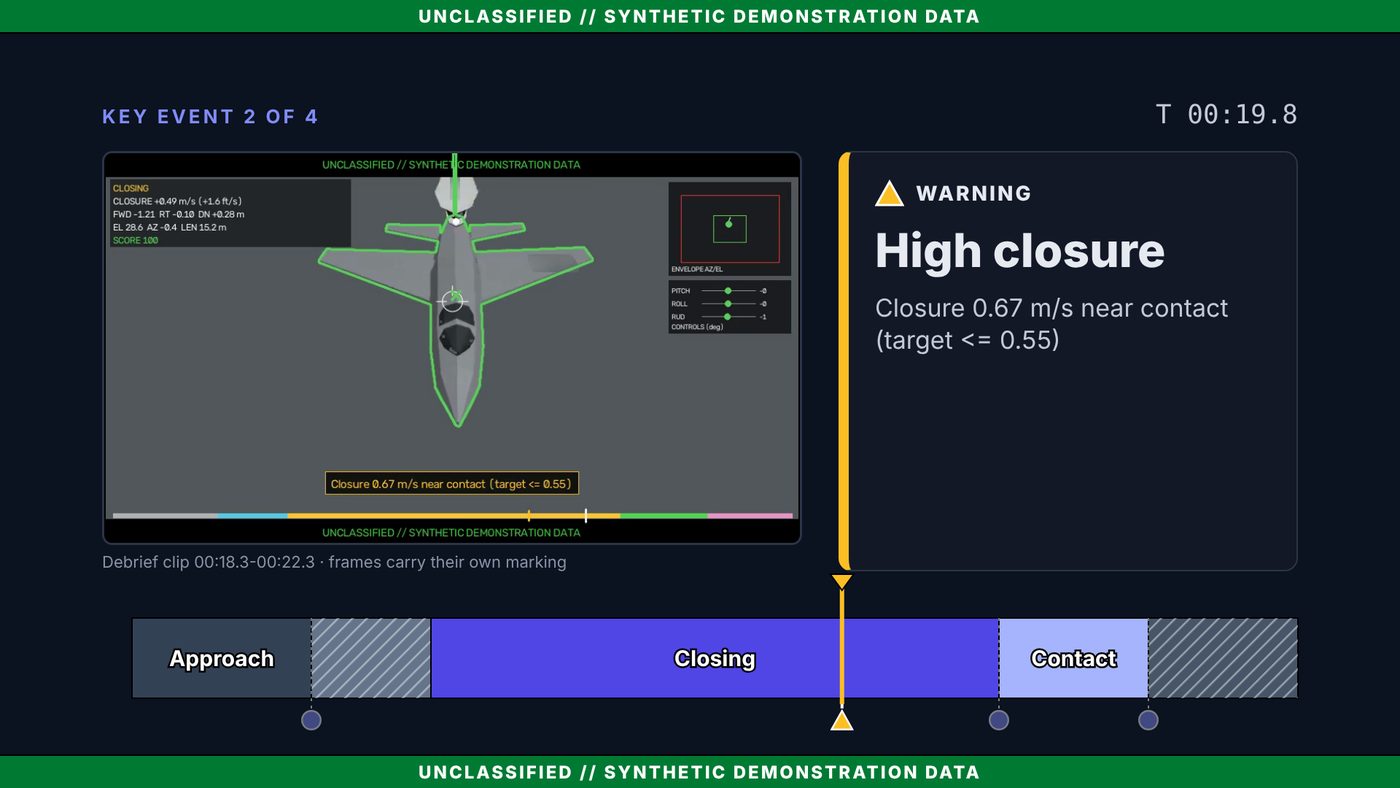
The phase strip runs left to right across the engagement: approach, pre-contact, closing, contact, disconnect and, if it happened, breakaway. Events sit on the strip as markers: blue for information, amber for warnings, red for critical. Click a marker to jump every view to that moment.
3. The video#
Two videos are produced. The debrief video shows the sanitized camera image with the fitted wireframe, live closure and offset readouts, an envelope inset, control-surface gauges and the phase strip. The sanitized video is the clean release product with no overlay. Both carry the classification marking on every frame.
4. The 3D replay#
The engagement rebuilt in 3D on the same playhead as the video. Use it to see geometry the camera cannot show, such as how far forward an overshoot went. See 3D replay and the AI view.
5. The envelope heat map#
Where the receiver's receptacle spent its time, relative to the boom envelope, during closing and contact. Green is the ideal zone, amber is inside the envelope, red is outside it. A well-flown contact is a tight green cluster.
6. Pilot inputs and control surfaces#
When telemetry includes stick and throttle, or when the receiver's flight data or bus capture is attached, the debrief shows how inputs relate to the motion. Even without them, control-surface positions are read from the video, so a pumping stick shows up as an oscillating elevator.
7. Radio and damage#
If a radio recording is attached it is transcribed on the box and laid on the timeline. Each deviation also shows its damage exposure: what that kind of mistake has cost in public mishap reports, scaled by how severe this one was.
What to take away#
The training section at the bottom turns the weakest categories into a focus area and recommended drills for the next sortie. Pilots see the same thing in their trend.