One system, from the boom camera
to the training record.
AARCV is a debrief tool for the receiver pilot, a review tool for the instructor, a release tool for the security officer and an operations console for the people who keep the model honest. All of it runs on one box with no network connection.
What each sortie produces.
Pick a view. Every screen below is the running product on synthetic sorties.
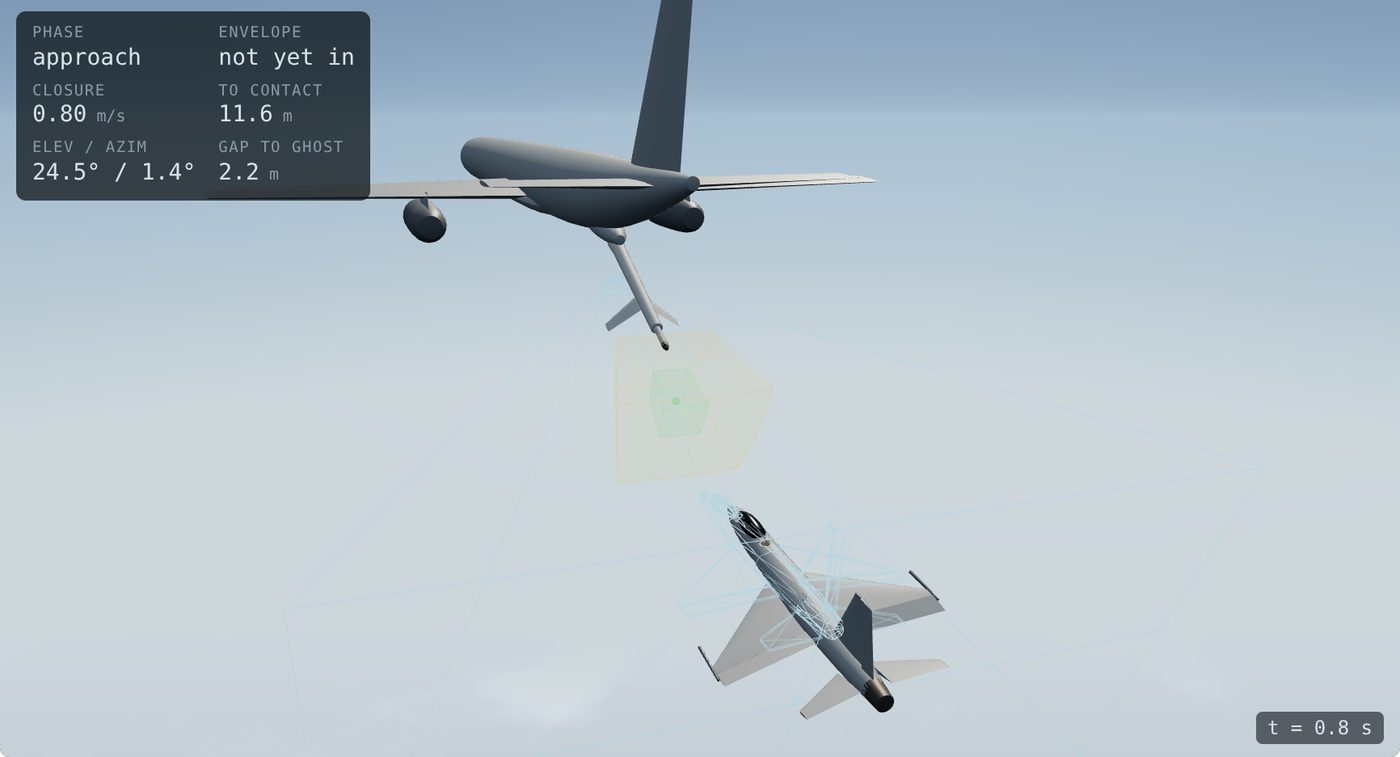
The engagement, rebuilt in 3D
Tanker, boom, envelope and receiver on the video's playhead. Orbit freely, switch to the boom operator's or the receiver pilot's eye, and lay a ghost of the ideal approach or a personal best over the sortie.
- Live phase, envelope state, closure and distance to contact
- Click any deviation to replay it with its cost exposure
- Control surfaces exaggerated so small inputs are visible
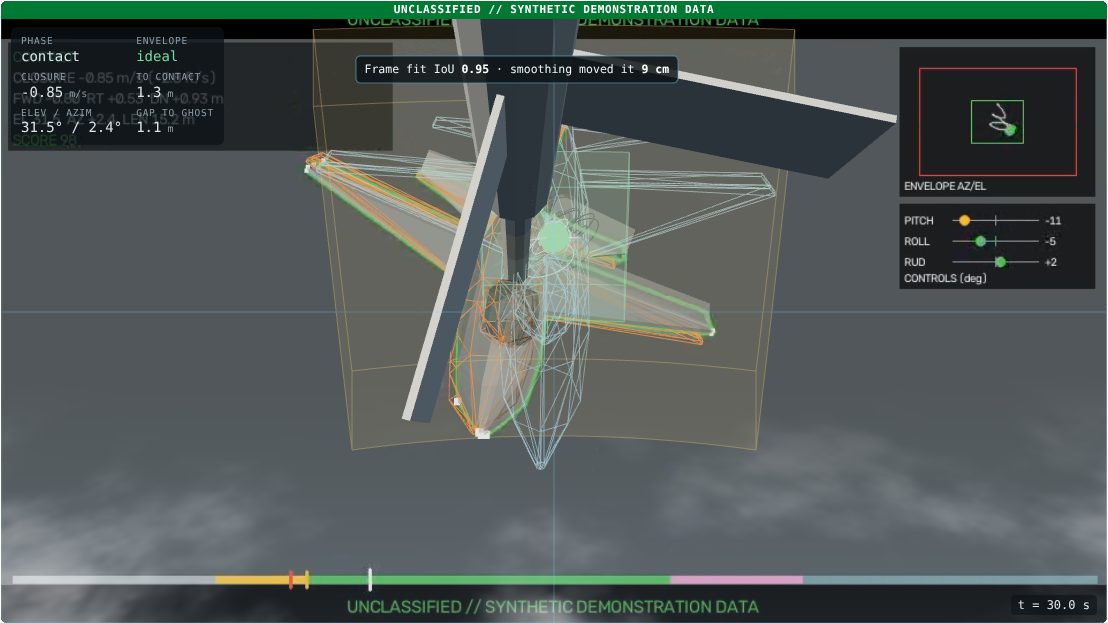
Answer the first technical question in five seconds
"How do you get 3D from one camera?" Freeze a frame and the fitted wireframe sits on the receiver with its fit quality, and how far smoothing moved it. Raw fits and the final track are drawn together, so instructors can see when to trust a number.
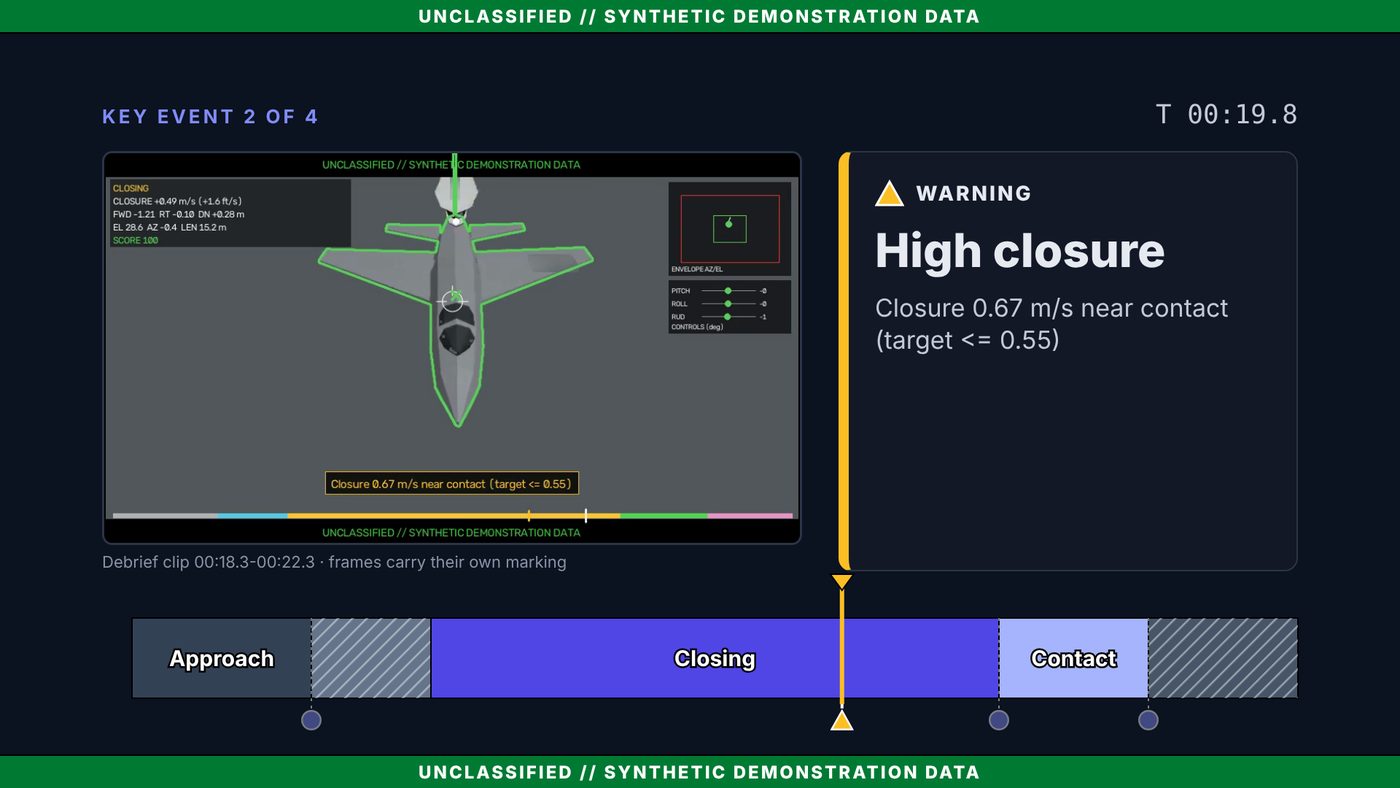
A two-minute hotwash, generated
Each sortie gets a short highlight reel: title, the score, every key event with its clip and the phase timeline. It is built from the sanitized video, and every frame carries its own marking.
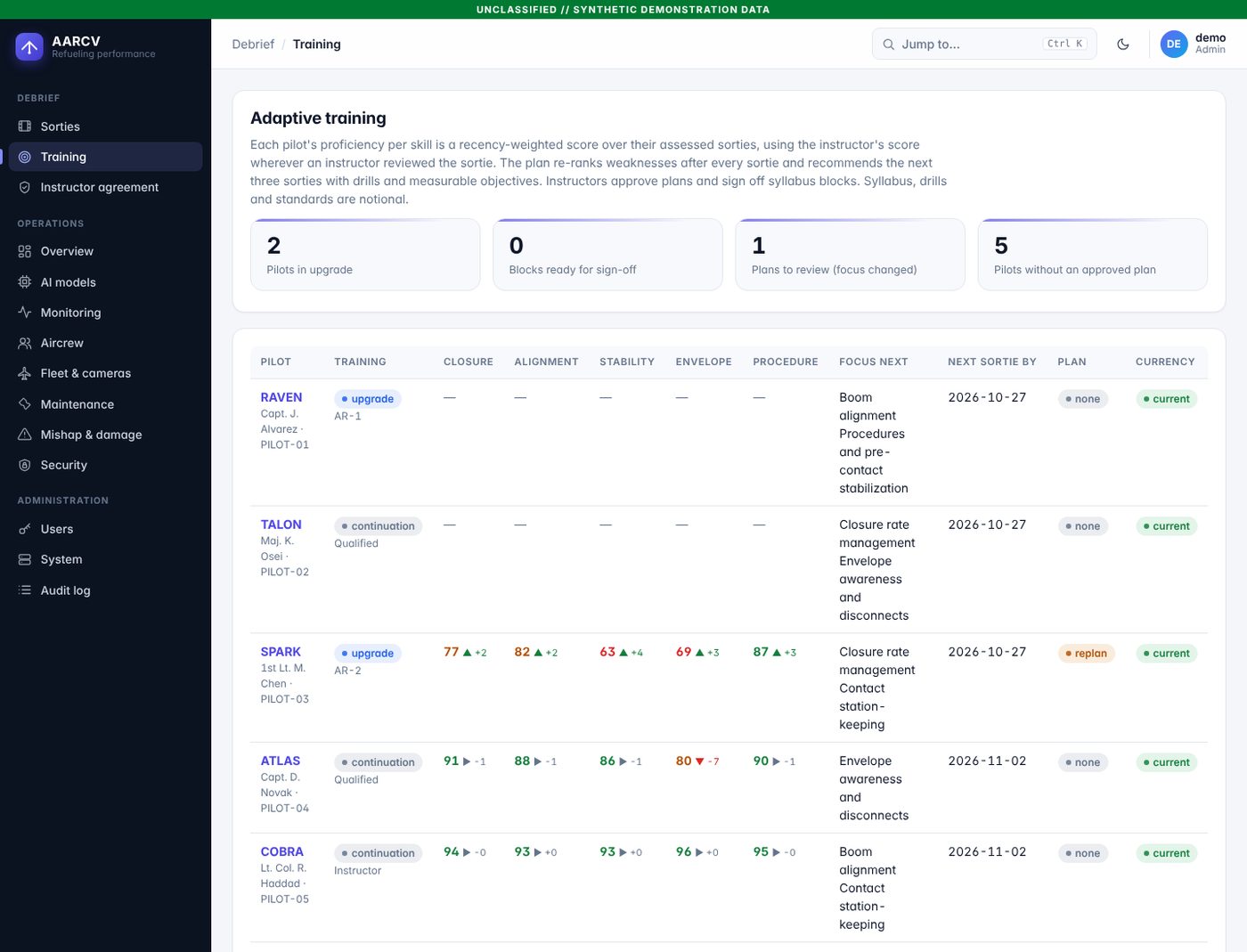
Training that follows the data
Category scores roll into a per-pilot focus area, recommended drills and a next-sortie plan. Instructors sign off, and the record travels with the pilot as a signed, verifiable file.
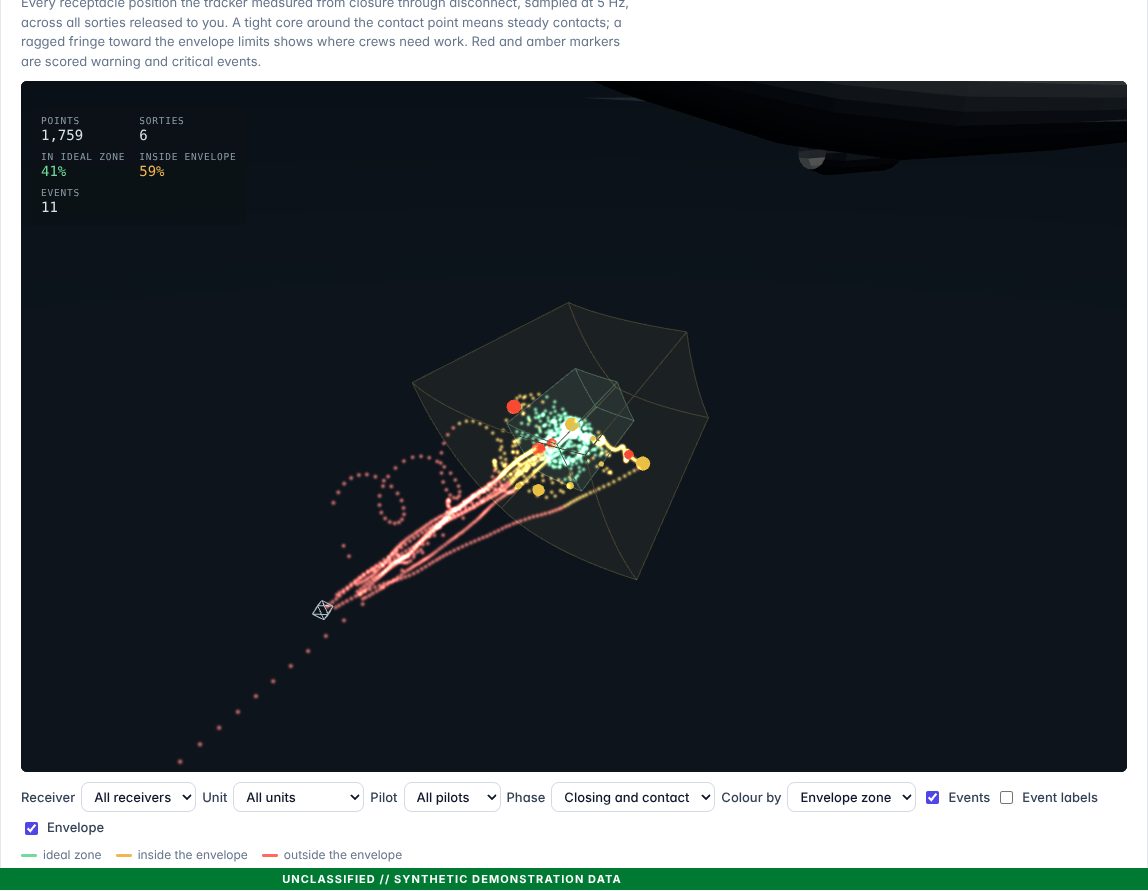
Every contact the fleet has made, in one picture
Receptacle positions from every assessed sortie, filtered by receiver, unit, pilot or phase. Where the fleet drifts toward the envelope edge is where training time should go.
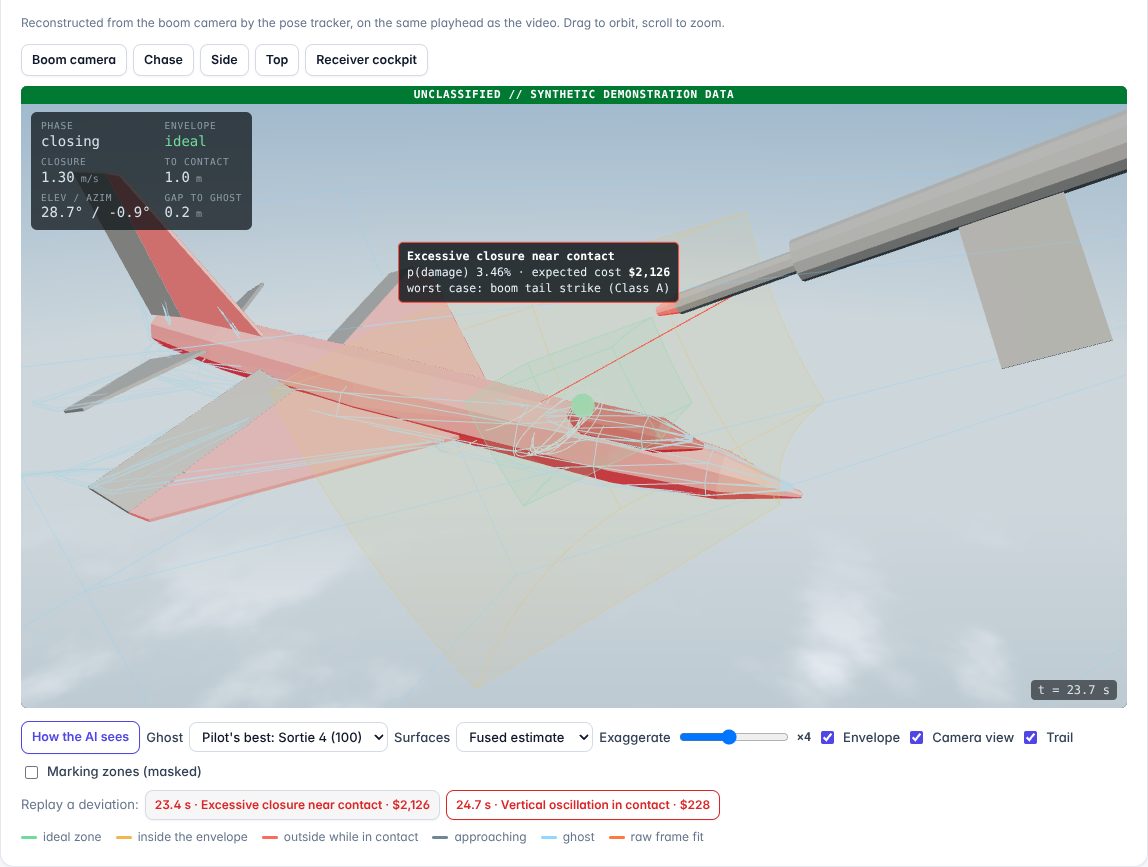
See what a deviation would have cost
Each deviation carries a damage exposure built from public mishap costs, so a debrief can say why a 0.3 m/s excess closure matters, in dollars and aircraft-days.
Each person sees what they need, and releases only what they may.
Receiver pilot
Score, replay and the three moments that mattered, the same day. A trend across sorties that shows what improved.
Instructor
Confirm or override each category and event in one screen. Overrides become training labels; agreement is tracked against the 95% objective.
Security officer
Policy-driven markings, a review queue for anything flagged, redaction tools and signed, verifiable release packages.
Maintainer
Camera calibration and built-in test, work orders opened automatically on drift, and boom and receptacle load history.
ML engineer
A model registry with evaluation gates, promotion and rollback, drift per camera and a labelling queue fed by disagreements.
Training office
Rubric weights and thresholds under version control, xAPI records for the learning system and simulator scenarios built from real sorties.
Ready for more than one squadron.
Prototype modules that take the core debrief from one unit to a fleet. Each is built and demonstrated on synthetic data.
Ground edge unit
Plug in the recording after landing; it processes locally and forwards when a link exists. No connection to aircraft systems.
Sites and capacity
Plan boxes per base from sorties per day, queue jobs across sites and sync products and models.
Learning loop
Mine hard examples, label them, freeze datasets and run retraining rounds behind evaluation gates.
Receiver onboarding
Add a receiver type from a specification and qualify it with a test plan before it is allow-listed.
Boom and receptacle health
Accumulate contact loads per component and flag inspections before damage shows.
Autonomy referee
Score automated-boom runs with the same rubric used for people, as an independent check.
Simulator export
Turn a sortie into a scenario for boom-operator and receiver trainers, so the next sim session rehearses the miss.
Coalition release
Release-profile previews and translated debrief strings for partner nations, under the same policy engine.
Runs where the video lives.
No GPU, no cloud dependency, no license server, no telemetry. The same container image runs on a laptop for a demo and in an accredited enclave.
Air-gapped enclave
A signed bundle on approved media. The installer verifies hashes, loads images and starts a TLS proxy in front of an app with no route out of the host.
Unit server
One 4-core box processes a 90-second engagement in under 11 minutes. Add workers or sites as sortie counts grow.
Hardened image
Read-only root filesystem, non-root user, CycloneDX SBOM and a posture check that writes RMF evidence.
Speaks the formats you already use.
| Area | Supported | Where to read more |
|---|---|---|
| Motion imagery | STANAG 4609 transport streams: H.264 with MISB ST 0601 KLV, ST 0102 security markings, ST 0604 time stamps. MP4, MOV and MKV with a CSV sidecar. | Ingest formats |
| Receiver flight data | Recorded flight data and MIL-STD-1553 bus captures, registered to the video clock automatically. | Flight data |
| Training records | xAPI statements and CSV; signed, portable proficiency records. | Training records |
| Release and custody | Signed export packages with hashes, signatures and a custody chain, verifiable offline with aarcv verify-package. | Custody and export |
| Supply chain | CycloneDX SBOM from aarcv sbom; posture checks from aarcv posture. | CLI reference |
| Automation | REST API with HTTP Basic over TLS, role-checked on every route. | REST API |
See it on your own sortie.
The full demo runs in Docker with seven synthetic sorties. Real recordings go through the same pipeline.