Every number, with its method.
The results below come from the prototype running on synthetic sorties with simulator truth, including 13 held-out sorties the frozen configuration had never seen. Misses are reported as measured. Every figure regenerates from one command.
Read this first. All imagery, telemetry and scores are synthetic. Simulator truth stands in for instructors; the instructor-agreement study and validation on Government-provided KC-46 video are Phase II work.
Five of six objectives demonstrated on synthetic data.
| Objective | Target | Demonstrated | Status |
|---|---|---|---|
| Automated debrief products after ingest | ≤ 15 min | 10.4 min worst case on held-out sorties (90 s clips, 4-core CPU) | Met |
| Track position, movement and refueling geometry | 6-DoF track from video | 1.84% median range error; 0.69 m mean position RMSE (held-out) | Met |
| Identify significant deviations | Events detected and timed | Precision 0.965, recall 0.944 within 2 s (held-out) | Met |
| ≥ 95% agreement with instructors | ≥ 95% | 95.0% of category scores within 10 points of truth; grades 12/12 (held-out) | Met on a proxy |
| Refuse unauthorized platforms | Refuse and purge | 13/13 allow-list decisions correct; unlisted platform rejected in 8.6 s, no imagery kept | Met |
| Integration with an operational training unit | ≥ 1 organization | Planned for Phase II | Planned |
It held up on sorties it had never seen.
Thirteen new sorties with new random seeds and a perturbation rule written before any of them was rendered. Rendered, processed and scored once. Nothing tuned afterwards.
| Metric | Development (7 sorties) | Held-out (13 sorties) |
|---|---|---|
| Category scores within 10 points | 96.7% (29/30; Wilson 83.3 to 99.4%) | 95.0% (57/60; Wilson 86.3 to 98.3%) |
| Grade agreement | 100% (6/6) | 100% (12/12) |
| Mean |video − truth| overall score | 1.05 | 2.39 |
| Mean position RMSE | 0.725 m | 0.686 m |
| Median relative range error | 1.94% | 1.84% |
| Mean phase agreement | 97.8% | 94.8% |
| Event precision / recall | 0.976 / 0.943 | 0.965 / 0.944 |
| Allow-list and status decisions | 7/7 | 13/13 |
The three held-out misses are reported in full in the validation report. On both fast-closure variants the video track under-reads a short forward overshoot by about 0.3 m, so the overshoot penalty is missed; on one unstable variant a 0.4 m range bias moved the closure peak just outside the 3 m scoring window. Both are known, systematic and left unfixed so the held-out set stays held out. The 95% point estimate is met, but with 60 categories the interval is wide; Phase II needs about 50 sorties to show it with confidence.
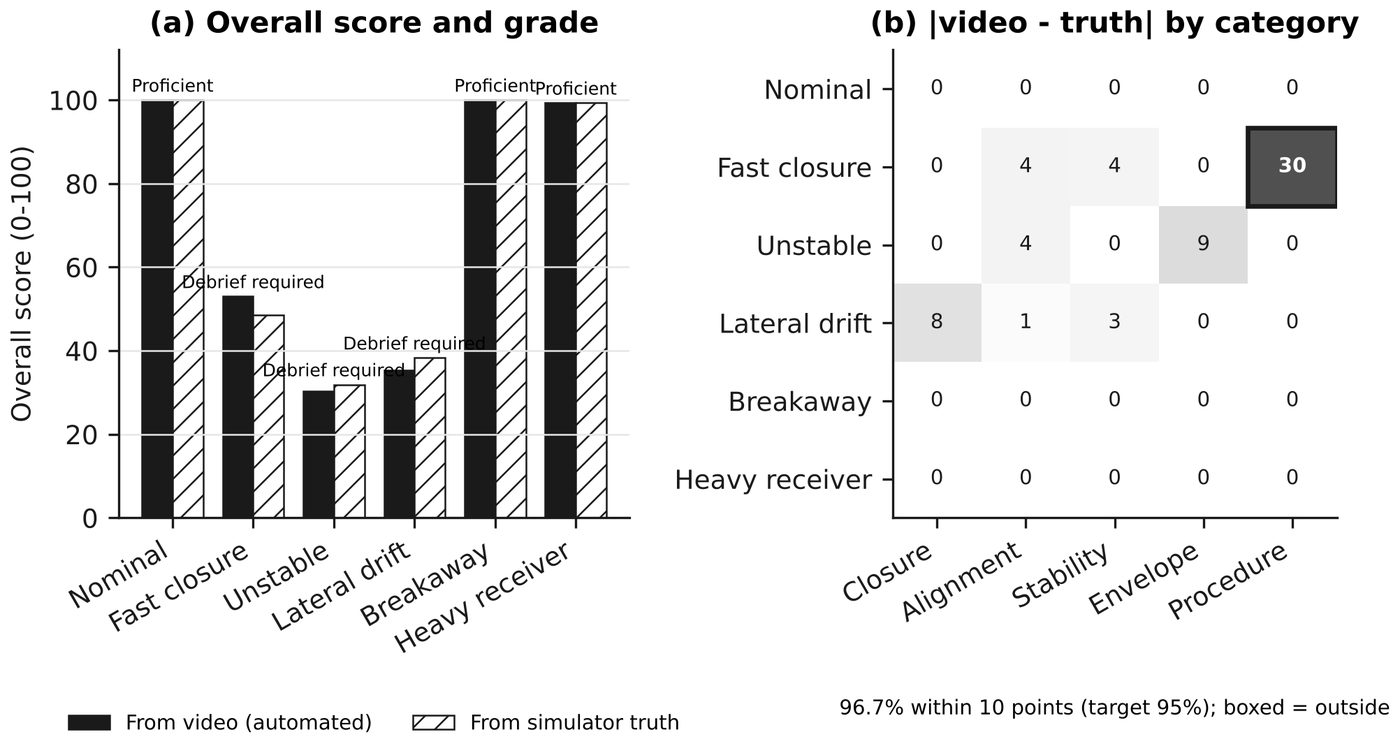
Scores from video agree with scores from truth.
The same rubric run on the tracked trajectory and on simulator truth. Grades agree on every sortie; 29 of 30 development category scores fall within 10 points.
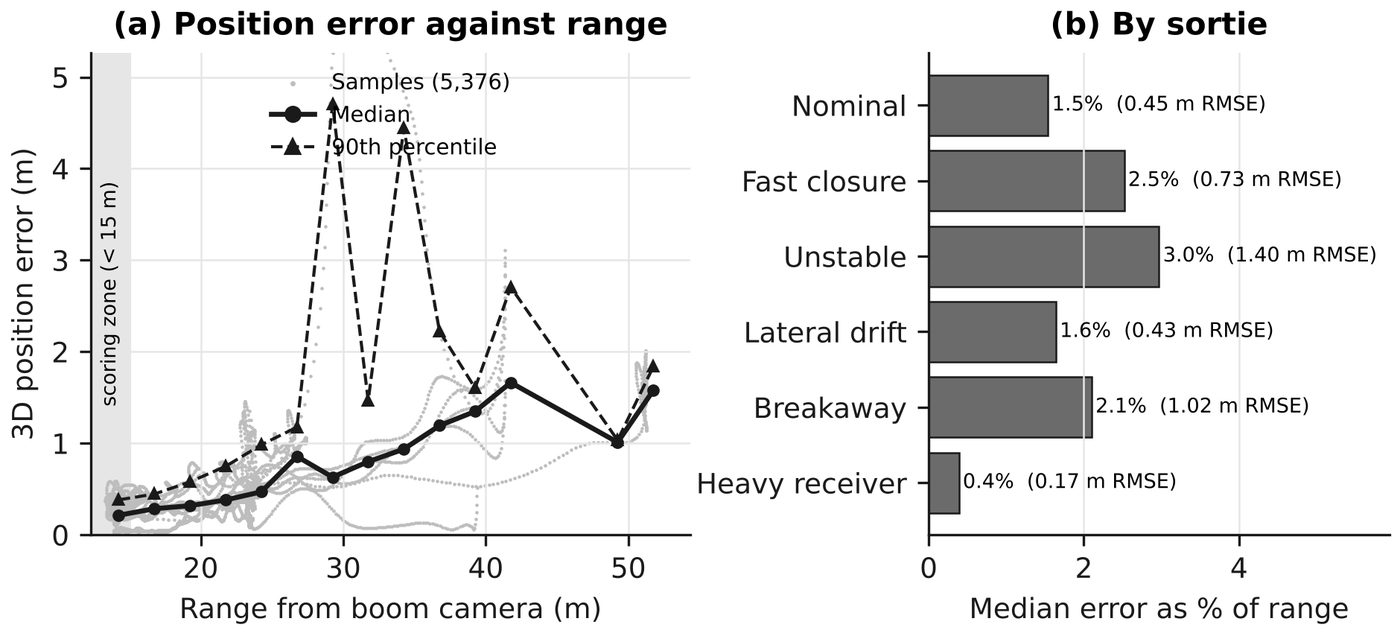
Centimeters where it counts.
Error grows with range, as it must for one camera. Inside 15 m, where scoring happens, median position error is 0.21 m (90th percentile 0.37 m) over 5,376 samples.
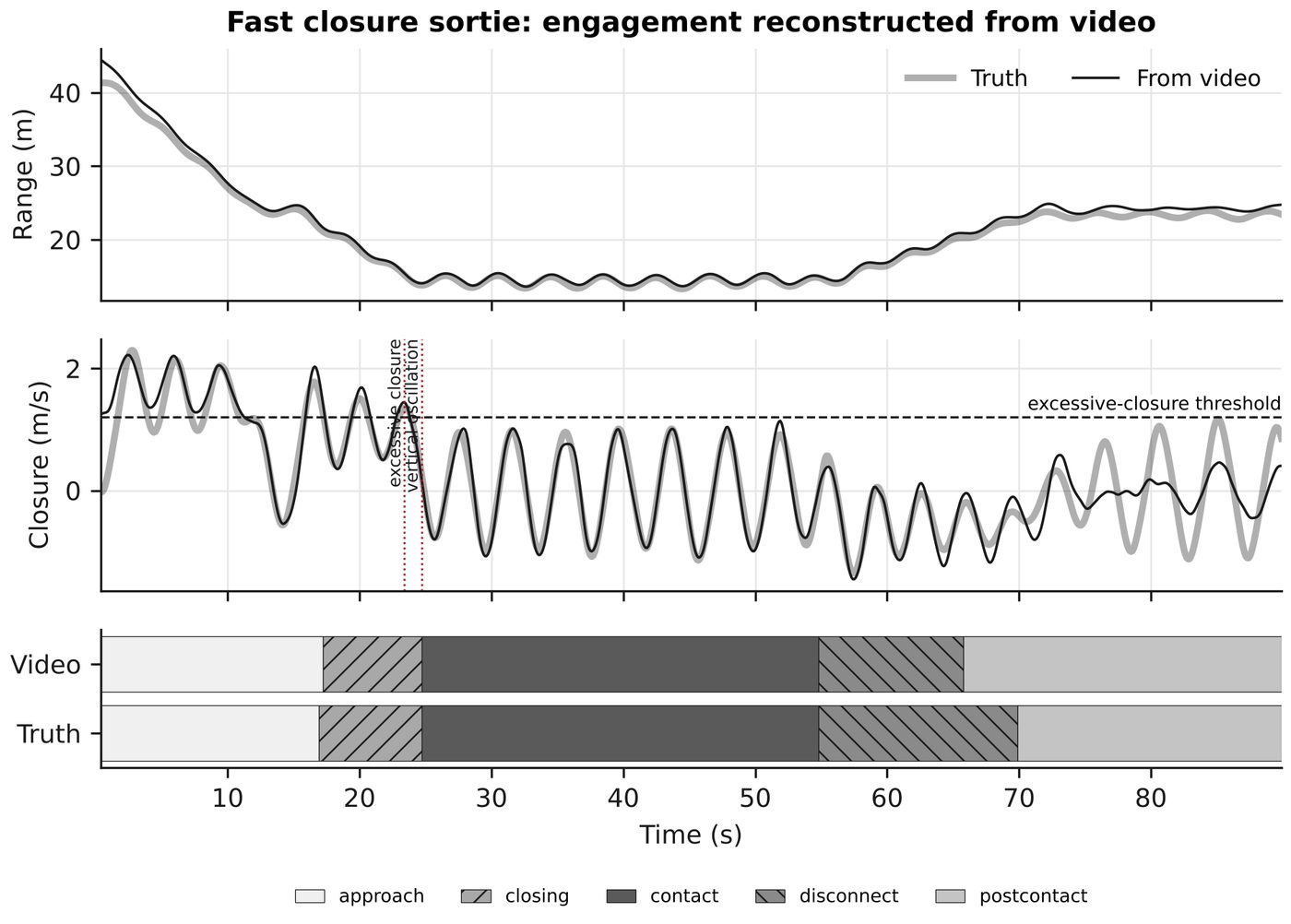
The engagement, second by second.
Range, closure rate and phase from video against truth for the fast-closure sortie. Closure-rate RMSE 0.29 m/s; the warnings and limits raised are marked where they happened.
Pilot inputs, read from the image.
Pitch and roll attitude and the stick inputs they imply are estimated from video alone, and get sharper when receiver flight data or a MIL-STD-1553 capture is fused.
| Mean correlation with truth | Video only | + flight data | + 1553 bus |
|---|---|---|---|
| Pitch attitude | 0.88 | 0.96 | 0.94 |
| Roll attitude | 0.78 | 0.97 | 0.95 |
| Stick pitch | 0.84 | 0.92 | 0.88 |
| Stick roll | 0.88 | 0.94 | 0.89 |
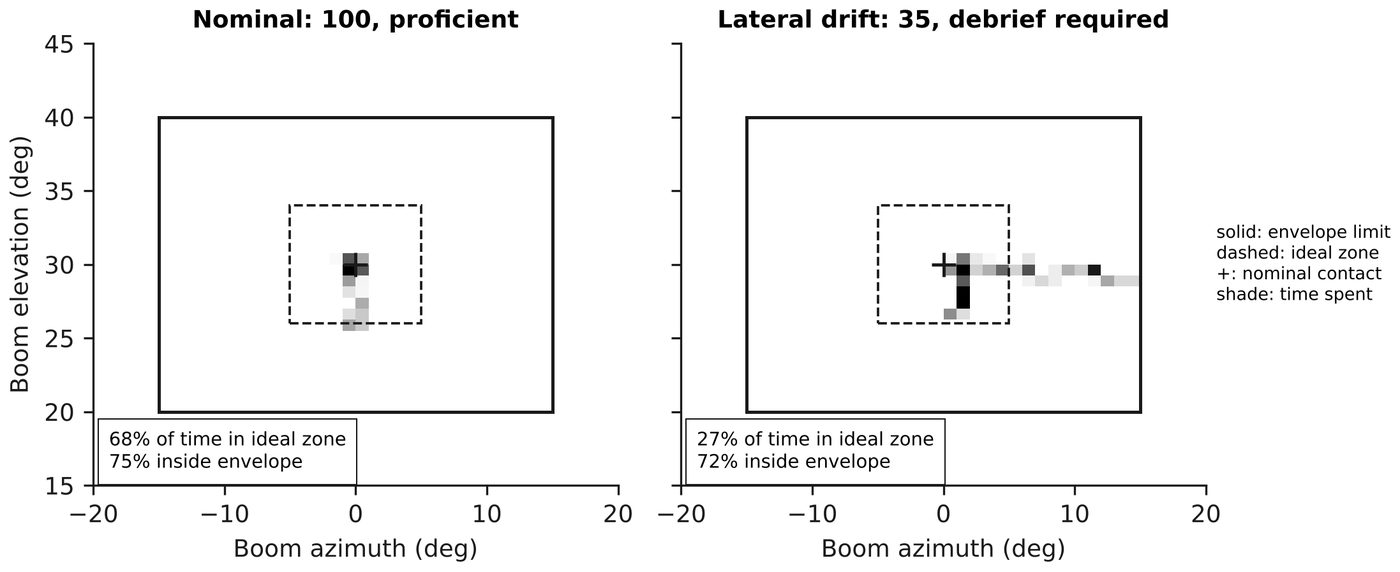
Envelope heat maps: the nominal receiver holds the ideal zone 68% of contact time, the lateral-drift receiver 27%.
Three commands, every figure.
The evidence pack records the commit, configuration hash, library versions and host it was generated on. The held-out set is generated from fixed seeds 101 to 113.
# development set and the figures
aarcv synth && aarcv batch --jobs 3 && python -m evidence.build

# held-out set (frozen configuration)
aarcv synth    --profiles heldout --out data/heldout/synthetic
aarcv batch    --profiles heldout --synthetic data/heldout/synthetic \
               --out runs_heldout --jobs 3
aarcv validate --profiles heldout --synthetic data/heldout/synthetic \
--runs runs_heldout --json runs_heldout/validation.jsonPublic mishap data, not marketing math.
Four KC-46 boom mishaps investigated by Accident Investigation Boards from FY2023 to FY2025 cost about $32.8M. Investigators cited excessive closure, contact outside the envelope, delayed breakaway and gaps in operator knowledge of the boom control logic. Those are the variables AARCV measures.
Savings are model estimates from public costs (see the damage model in the repository), not measured results.
Next: real KC-46 video.
Phase II replaces synthetic truth with Government-provided recordings and instructor panels, and swaps the template fitter for a learned perception model built with our research partner.