Every refueling contact, scored objectively.
AARCV turns the video the tanker already records into a debrief the receiver pilot can trust: closure, alignment, stability and envelope, measured from the image and replayed in 3D. The video is marked, redacted and released automatically under classification guidance.
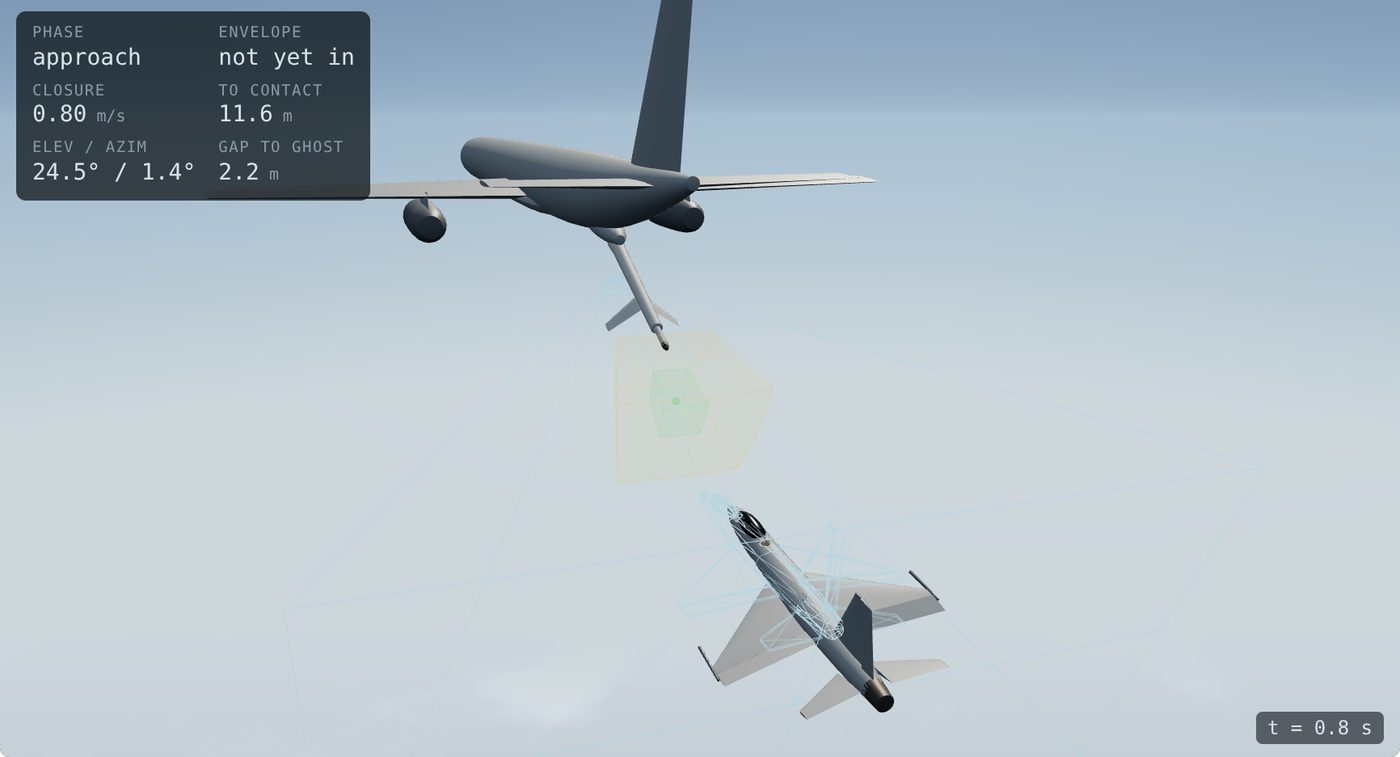
Live view: a synthetic sortie replayed through the same geometry the debrief uses.
The most expensive refueling mistakes are the ones nobody measured.
Refueling proficiency is still judged by instructor observation, pilot self-assessment and manual video review. The variables that investigators keep citing after boom mishaps, closure, contact outside the envelope and a late breakaway, are exactly the ones a person cannot measure by eye.
$32.8M in four mishaps
Public Accident Investigation Board reports put four KC-46 boom mishaps from FY2023 to FY2025 at about $32.8M in damage, roughly $10.9M a year.
Aircraft off the line
The Air Force calls the refueling subsystem the largest detractor of KC-46 availability. Each boom or receptacle repair takes a tanker, and often a receiver, out of service.
Feedback that does not compound
Hours of boom-camera video are recorded and rarely reviewed. Without objective scores there is no trend line, no early warning and no way to show a pilot is improving.
From recording to hotwash in one pass.
The same pass that measures the engagement also produces the sanitized, releasable video. Nothing leaves the box unmarked.
Ingest what is already recorded
Drop in a boom-camera recording with its KLV metadata, or plain video with a telemetry file. The marking is settled before anything is copied.
Track the receiver in 6-DoF
A 3D template is fitted to every analysis frame, so position, attitude and even control-surface deflection come from the image itself.
Score against the rubric
Phases, events and five category scores: closure, alignment, stability, envelope and procedure. Every number links back to the frames behind it.
Debrief, then learn
Pilots get a replay, a heat map and a trend. Instructors confirm or override, and every override becomes a training label.
A grade a pilot can argue with, because it shows its work.
Each sortie gets an overall score and five category scores on a 0 to 100 scale, weighted by a rubric your training office controls. Try the three example sorties.
See the engagement from angles the camera never had.
The tracked engagement is rebuilt in 3D on the same playhead as the video. Orbit around it, fly it from the receiver cockpit, lay a ghost of the ideal approach or the pilot's best sortie over it, and jump straight to each deviation with its damage exposure.
- "How the AI sees" view: the frame, the fitted wireframe and its fit quality
- Ghost comparisons against the ideal or a personal best
- Control surfaces read from video and fused with flight data
Releasable by default. Not by afterthought.
Analytics run only while an allow-listed receiver is in view. Terrain is removed, markings blurred, burned-in overlays blacked out and metadata stripped, then every frame is screened and marked. Drag to compare.
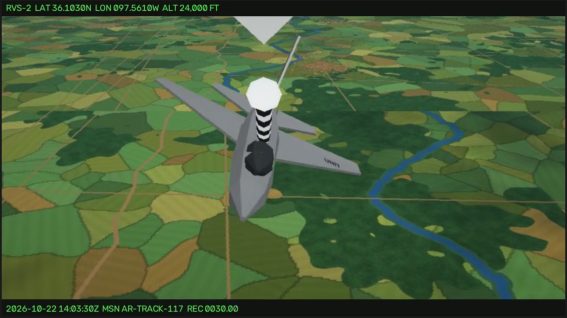
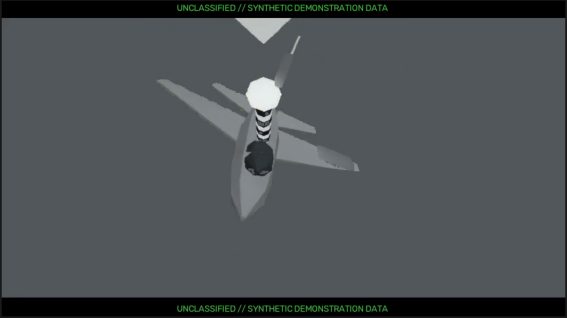 Raw cameraSanitized
One instant from a synthetic sortie, as recorded, as released and as shown in the debrief.
Fewer boom strikes pay for the program.
Move the sliders. The defaults are the public mishap costs and the method in our damage model: receiver-attributable share of the annual cost, times the reduction you expect from objective debriefs.
Defaults: four public AIB reports, FY2023 to FY2025 ($32.8M over three years). Base case 25% reduction; our low and high cases are 10% and 40%. Estimates, not a guarantee.
The only debrief that starts from the tanker's own video.
Other tools grade simulators, instrumented pods or flight-data parameters, or automate the boom in real time. AARCV grades the receiver after the flight from the recording the tanker already makes, so it needs no aircraft modification.
| Instructor review | Pod-based air-combat debrief | Simulator grading | Real-time boom automation | AARCV | |
|---|---|---|---|---|---|
| Works from video already recorded on the tanker | Manual | No | No | Live only | Yes |
| Objective scores for the receiver pilot | No | Not for refueling | In the sim | Not its job | Yes |
| Evidence behind every score (frames, events) | No | Partial | Partial | No | Yes |
| Automated marking and redaction of video | No | No | n/a | No | Yes |
| No aircraft modification | Yes | Pod required | Yes | Major | Yes |
| Runs disconnected, on one CPU box | Yes | Varies | Varies | Yes | Yes |
Categories, not vendors. Based on public information as of November 2026; see our market notes for sources.
Help center
Upload a sortie, read a debrief, review as an instructor and release video safely.
Browse guidesDevelopers
REST API, ingest formats, the assessment schema and signed export packages.
Read the docsEvidence
Every number on this site, with its method, the held-out test and how to reproduce it.
See the resultsBring a sortie. We will debrief it.
We are maturing AARCV on Government-provided KC-46 video with a university research partner. Talk to us about a demonstration, a pilot unit or a research collaboration.